
The Royal Ontario Museum is not a one-hour stop: ROM reports 18 million artworks, cultural objects, and natural history specimens spread across 40 gallery and exhibition spaces. That scale explains why it drew 1,114,325 visitors in 2024, but it also creates the main planning problem. A first visit works better when it is edited hard, with priority given to the galleries that justify the trip and enough time left for any paid temporary exhibition.
The museum’s fossil galleries, major cultural collections, and high-performing special shows compete for attention, while the location at Queen’s Park makes transit planning more useful than driving advice. Museum Station is the obvious name on the TTC map, but accessibility changes the route for some visitors. The point is not to see everything; it is to avoid wasting the best two hours inside Canada’s biggest museum.
What the museum is known for
Few Toronto attractions can jump from a Tyrannosaurus skeleton to Chinese temple art to Canadian material culture without changing buildings, and that range is the main reason this museum rewards planning. The Royal Ontario Museum describes itself as Canada’s largest and most comprehensive museum, with 18 million artworks, cultural objects, and natural history specimens across 40 gallery and exhibition spaces. That scale is not just marketing copy; it explains why a casual wander can feel rich for the first hour and slightly scattered after that.
The strongest draw is the mix of natural history, world cultures, and Canadian history under one roof. Natural history brings the crowd-pleasers: dinosaur fossils, mammal displays, biodiversity material, and mineral galleries that work well even for visitors with limited museum patience.
The world-cultures galleries widen the visit considerably, with collections connected to ancient Egypt, Greece and Rome, East Asia, Africa, the Middle East, and Europe. Canadian history and Indigenous art give the museum a local and national anchor, shifting the experience from “big global collection” to something rooted in this country’s own histories, artistic traditions, and contested inheritances.
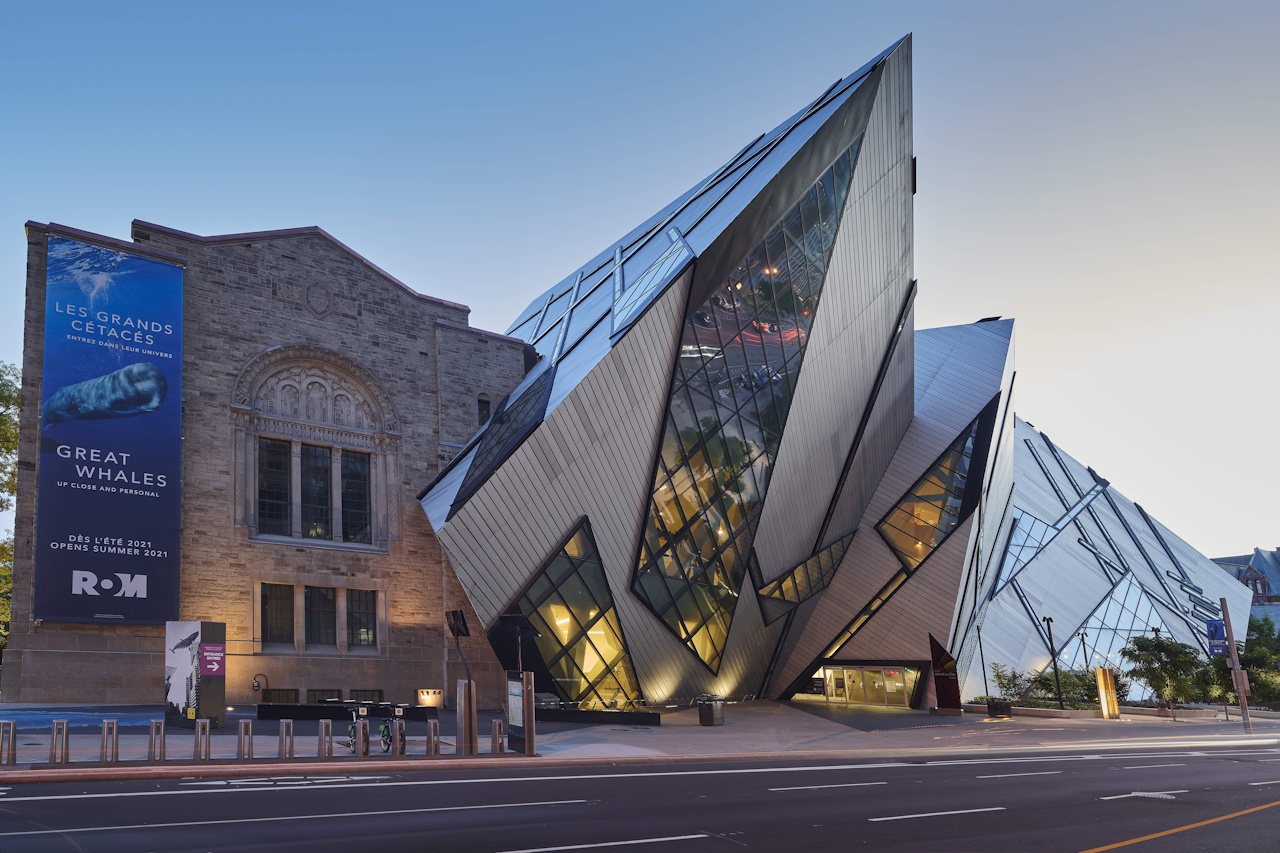
The building makes its point before the ticket scan. The Michael Lee-Chin Crystal, the angular glass-and-aluminum addition facing Bloor Street, gives the entrance a sharp, contemporary jolt against the older stone building behind it.
It is not subtle, and that is partly the point: the first impression is less grand old institution, more collision between eras. For visitors arriving on foot from Museum or St. George subway stations, the exterior also works as an easy landmark at the edge of the University of Toronto precinct.
The catch is simple: breadth can dilute focus. A short visit should not try to “do” the whole place. The payoff comes from choosing a lane first, then adding one contrast gallery if time allows: fossils and minerals for natural history, Indigenous art and Canadian material for local context, or one major world-cultures area for depth rather than a rushed checklist.
Best galleries to prioritise on a first visit
The dinosaur halls draw the obvious crowd, but the strongest first-visit route pairs them with ancient Egypt and one deep East Asian collection rather than trying to clear the building. The James and Louise Temerty Galleries of the Age of Dinosaurs are still the easy win for families and first-timers: big specimens, clear sightlines, and enough visual payoff that younger visitors do not need a long label-reading attention span. They are also where crowding builds fastest on weekends, so this is the gallery to hit early rather than saving it for the end of a tired visit.
For visitors who want something with more texture than a greatest-hits fossil stop, Willner Madge Gallery, Dawn of Life deserves priority. Opened in 2021, it covers early life through an unusually dense fossil story, and the museum said at launch that the gallery spans a 10,000-square-foot space with almost 1,000 fossil specimens. That makes it a better use of time for general-interest visitors who like science but do not want the full kid-heavy energy of the dinosaur rooms.
Ancient Egypt is the other safe first-visit pick because it works across ages and levels of prior knowledge. Mummies, funerary objects, sculpture, and daily-life material give the gallery a clear narrative without requiring specialist context.
It is also a useful reset after the louder natural-history sections, since the draw is detail rather than spectacle. Families should still pace it carefully; this is stronger as a focused 25-minute stop than as a slow march through every case.
The Chinese and broader East Asian holdings reward repeat visits, but they should not be treated as optional filler on a first trip. The Chinese temple art, architecture, and sculpture galleries offer some of the museum’s most distinctive permanent rooms, especially for visitors who have already seen dinosaur-heavy museums elsewhere. They are quieter than the blockbuster zones, which makes them a smart second-half choice when the main halls start to feel packed.
Temporary exhibitions can beat the permanent favourites when the subject is strong. The museum’s Annual Report says surcharged exhibitions drew 412,536 visitors in FY2024–25, and its Year in Review reported that Auschwitz. Not long ago.
Not far away. drew close to 165,000 visitors. The practical takeaway is simple: if a major special show is running and the subject fits the visit, drop one permanent gallery rather than rushing everything.
Getting there by TTC and planning the visit
The cleanest TTC route drops passengers almost at the front door: take Line 1 to Museum Station and exit toward Queen’s Park rather than trying to thread across downtown by car. ROM sits on Bloor Street West beside the University of Toronto, with the Annex immediately to the west, so the subway is not just convenient; it is the sane choice for this part of the city. From Line 2, transfer at St. George, or walk east from St. George along Bloor if the weather is decent and the extra few minutes are welcome.
Accessibility changes the route. TTC lists Museum Station at 75 Queen’s Park as not accessible, and ROM advises riders who need an elevator to use St. George Station instead; TTC says Museum Station’s elevator project is scheduled for completion by Q3 2026. That makes St. George the safer default for strollers, mobility devices, or anyone avoiding stairs, even though it adds a short surface walk.
Crowd pressure is most noticeable when weekend families, school groups, and special-exhibition visitors overlap in the late morning and early afternoon. The museum drew 1,114,325 visitors in 2024, according to The Art Newspaper, so this is not a place where arriving “whenever” pays off.
Weekdays are generally calmer, but mornings can still feel busy during school-visit season. For a smoother visit, aim for opening time on a weekday or later in the afternoon after group traffic thins.
A focused first visit usually takes about two to three hours if the plan is to hit priority galleries without reading every label. Four hours is a better allowance for visitors adding a major paid exhibition, eating on-site, or moving at a slower pace with kids. The surrounding blocks around Bloor, Queen’s Park, and the university fill up quickly at peak times, so building in a few extra minutes for the walk from the station is practical, not overcautious.
Tickets, special exhibits, and nearby stops
A $9 add-on can change the whole value calculation if the temporary show is the reason for going in the first place. General admission usually covers the permanent galleries, while major special exhibitions and some seasonal programming sit on top as surcharged tickets or timed-entry add-ons. As of 2026, Psychedelics: Art.
Culture. Science. runs to December 6, 2026 with a $9 surcharge, according to ROM’s exhibition information, while its summer BEES programming lists surcharges of $13 for adults and $8 for children through October 18, 2026. The practical move is to price the full ticket before committing, not after arriving at the admissions desk.
Special exhibitions are often the best reason to revisit, but they narrow the margin for casual planning. Popular shows can sell through faster, use timed entry, or add enough time to make a same-day sprint through the permanent galleries feel rushed. If the surcharge exhibition is the priority, build the visit around that entry window and treat the permanent collection as the flexible part of the day.
The area immediately around the museum has better pairings than a second big attraction across town. Queen’s Park is the easiest decompression stop: it is close, leafy, and useful after a dense indoor visit.
The Gardiner Museum, directly across Queen’s Park, works well for visitors who still want another compact cultural stop without crossing the city. Koerner Hall at the Royal Conservatory of Music is also nearby, and checking its concert schedule can turn a museum afternoon into a clean evening plan without needing a car.
Food is strongest when the route stays walkable. For coffee or a light bite near Bloor and St. George, L’Espresso Bar Mercurio is the obvious practical stop before or after the museum.
Yorkville has sit-down options such as The Oxley if the plan is to linger, while the Annex is better for a cheaper, looser meal after walking west along Bloor. Skip the urge to drive somewhere “better”; this corner of the city rewards staying on foot and using the subway when the next neighbourhood is more than a short walk away.
Why the best ROM plan starts before the front doors
ROM rewards a planned visit more than a long one. The cleanest move is to choose the paid exhibition first, check whether a surcharge applies, then build the rest of the visit around two or three permanent-gallery priorities. Transit should be decided with the same care.
Museum Station sits beside the building, but it is not accessible, and the elevator project is listed for completion in Q3 2026; visitors needing step-free access should use St. George Station instead. That single routing choice can change the whole day, especially with kids, school groups, or limited time. The best ROM visit starts before the entrance doors, at the station and ticket screen.
Frequently Asked Questions
Q: How much time should be set aside for the Royal Ontario Museum?
A: A solid visit usually takes 3 to 4 hours, which is enough to see a few major galleries without rushing. A full-day visit makes more sense for families, special exhibitions, or anyone planning to read exhibits in detail. The museum is large enough that a shorter stop often feels incomplete.
Q: What is the best way to get to the museum without a car?
A: The museum is easiest by TTC. The closest subway stop is Museum Station on Line 1, and the walk from there is short and direct. Bloor Street buses and nearby subway connections also make it simple to pair the visit with Yorkville or the Annex on foot.
Q: Which galleries are usually the best first stop inside the museum?
A: The dinosaur and natural history galleries are the most reliable crowd-pleasers, especially for first-time visitors. The Canadian, Asian, and Egyptian collections are also strong because they give a broad sense of the museum’s range. Starting with the busiest galleries early in the day usually makes the visit smoother.
Q: Is the museum good for families with children?
A: Yes, but the visit works best when it is paced carefully. The most interactive and visually striking galleries hold attention better than sections that rely on dense labels or long reading. Shorter visits with one or two main priorities are usually more successful than trying to cover everything.
Q: What nearby areas are worth pairing with a museum visit?
A: Yorkville is the most practical add-on because it is an easy walk and has plenty of cafes and shops. The Annex is also close enough for a simple transit or walking extension if a longer neighbourhood loop is planned. Staying on foot keeps the day efficient, since the area is well connected by subway and streetcar routes.