
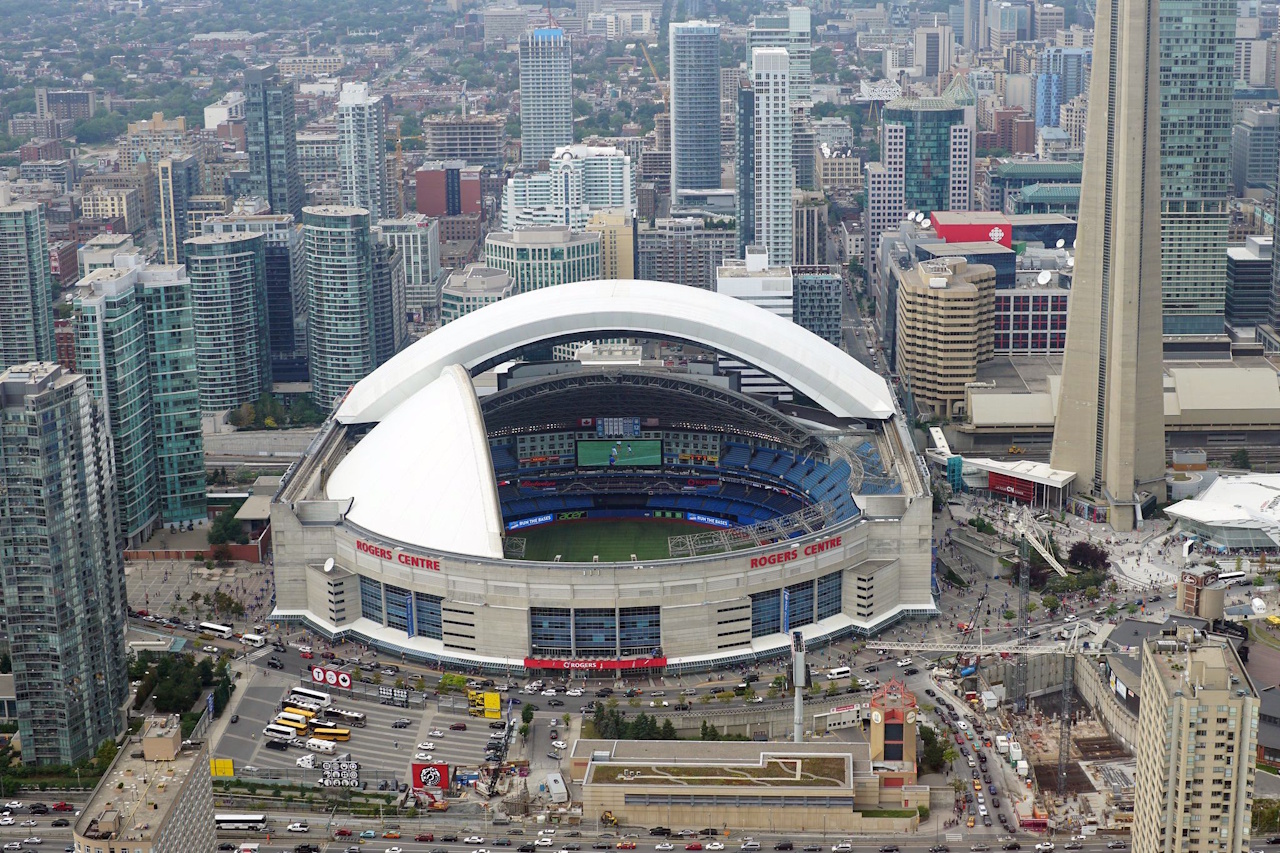
Rogers Centre occupies 11.5 acres at the base of the CN Tower, with the full downtown complex covering 12.7 acres beside some of Toronto’s busiest rail, subway, and pedestrian routes. That scale matters because the stadium is not a drive-up suburban venue; it works best as a Union Station trip with a short walk attached. From the Great Hall, the route takes about 10 minutes, including the 160-metre SkyWalk connection toward the CN Tower and stadium gates.
The building itself is also more than a big roof over a ball field: its retractable roof has three movable panels, weighs 11,000 tons, and takes about 25 minutes to open or close. Recent Blue Jays renovations have made the lower bowl and outfield more baseball-specific, while game-day rules around gates, bags, bottles, and cashless payment can shape the visit before the first pitch.
Where it sits in downtown Toronto
Few Toronto sports addresses are easier to place on a map: 1 Blue Jays Way sits tight against the CN Tower, just north of Lake Ontario and west of the busiest part of the Financial District. The stadium is not hidden in a suburban parking field or pushed to the edge of town. It is embedded in the downtown core, between the rail corridor, the waterfront, Front Street, and the cluster of attractions around Bremner Boulevard.
The scale explains why the building feels so dominant at street level. The full complex covers 12.7 acres, while the building itself takes up 11.5 acres in downtown Toronto at the base of the CN Tower, according to the Toronto Blue Jays. That footprint matters for navigation: the blocks around it are wide, busy, and shaped by rail infrastructure, so the closest-looking route on a map is not always the cleanest walk.
The site opened on June 3, 1989 on the former Railway Lands, a stretch of downtown that has since become one of Toronto’s most walkable visitor zones. From Union Station, the walk is typically about 10 minutes via the SkyWalk and the CN Tower area, which is usually the simplest route for anyone arriving by subway, GO train, or UP Express. The waterfront is also close on foot, with Harbourfront and Queens Quay sitting south of the rail corridor, while nearby downtown landmarks such as Scotiabank Arena, Metro Toronto Convention Centre, and Ripley’s Aquarium are within an easy walk.
The central location is the main advantage, but it also means the surrounding streets can clog fast. On busy dates, the smarter move is to treat the area as a transit-and-walking district, not a driving destination.
How to get there without a car
On game nights, the fastest route is often the one that never touches Front Street: rail into Union Station, then the short walk west. Union is the practical hub because it ties together TTC Line 1, GO Transit trains and buses, VIA Rail, and the UP Express. Metrolinx describes the station-to-stadium walk as about 10 minutes from the Great Hall, which is short enough that waiting for a cab nearby usually loses time instead of saving it.
For TTC subway riders, Line 1 is the cleanest approach. Exit at Union for the most direct signed route, or use St. Andrew Station if arriving from the west side of downtown and the crowd flow south of Front Street looks heavy. Both options keep the final leg walkable and avoid the slow crawl that builds around the entertainment district before first pitch and after concerts.
Streetcars also work well when starting from neighbourhoods that are awkward by subway. The 510 Spadina streetcar puts riders close from the northwest side of downtown, with Front Street or Bremner Boulevard stops leaving only a short walk east. The 509 Harbourfront streetcar from Union serves the waterfront corridor and can be useful when coming from the west end or connecting through Queens Quay, though walking from Union is still faster for most able-bodied visitors when sidewalks are clear.
The main tradeoff is the exit. Transit is still the best call, but post-game crowds funnel hard toward Union, especially after a close finish when everyone leaves at once.
Anyone heading north can reduce the crush by walking to St. Andrew before boarding Line 1; anyone heading west can walk toward Spadina and pick up the streetcar away from the tightest station queues. Driving and ride-hailing put the trip back into downtown traffic, which is exactly the problem transit avoids.
What the stadium is built for
The signature feature is not the field; it is the roof, a huge mechanical lid that lets the building switch from open-air baseball to weather-protected event space in about the time it takes to finish a couple of innings. According to the Toronto Blue Jays, the retractable roof has three movable panels and one stationary panel, takes about 25 minutes to open or close, weighs 11,000 tons, and covers 339,343 sq. ft.
That engineering matters in Toronto, where spring baseball can mean cold wind, rain, or both. It also explains the tradeoff: the building is practical before it is graceful.
At 86 m high, the stadium reads as a large indoor-capable arena as much as a ballpark. The roof gives operators control over weather, lighting, and event setup, which is exactly why the venue has outlived the novelty phase of retractable-roof design.
Open-air parks tend to win on charm; this one wins on reliability. That is the real value for anyone planning around a ticketed event rather than admiring architecture from the sidewalk.
Baseball still defines the place. Capacity is listed at 39,150, and the building is home to the Toronto Blue Jays of Major League Baseball.
Recent baseball-focused work reinforces that priority: during the 2023–24 offseason rebuild of the 100 level, the Blue Jays said foul territory was reduced by about 3,000 sq. ft., with roughly 400,000 worker hours logged on the project. Those numbers point to a venue being tuned for sightlines, field proximity, and the modern MLB experience, not just preserved as a late-1980s multipurpose dome.
Ownership by Rogers Communications also shapes what the building is built to do. A corporate-owned, roofed stadium with major-league capacity is designed for high-volume professional sports and large indoor-capable events, with operations scaled for tens of thousands of people moving through gates, concourses, seating bowls, washrooms, concessions, and transit exits.
The result is not intimate, and it is not especially subtle. It is a big machine built to keep major events running when the weather does not cooperate.
What visitors should expect around game day
The last half-hour before first pitch is when the district stops feeling convenient and starts moving at stadium speed. The ballpark shares a compact downtown pocket with the CN Tower, Roundhouse Park, hotels, bars, patios, and other ticketed attractions, so game traffic mixes with tourists, commuters, dinner crowds, and people just cutting across the area. That makes pre-game wandering easy, but it also means sidewalks, crosswalks, and plaza entrances slow down quickly once lineups build.
Arriving early is the cleanest fix. According to the Toronto Blue Jays Information Guide, gates open 90 minutes before first pitch on weekdays and 2 hours before game time on Saturdays and Sundays, which gives enough room for security screening, food, washrooms, and finding seats without joining the worst crush. Showing up right at start time saves no meaningful time; it just shifts the wait to gates, concourses, and concession lines.
Small practical details matter on busy dates. The same Blue Jays guide says bags larger than 16 in. × 16 in. × 8 in. are not permitted, non-alcoholic plastic bottles or cans must be 600 ml or less, and the venue is cashless, with reverse ATMs on the 100, 200, and 500 levels.
Those rules are not trivia. They decide whether entry is quick or whether a visitor gets pulled aside while thousands of people are trying to move through the same doors.
For venue-specific questions before heading out, the direct stadium phone number is (416) 341-1000. That is the better contact point for current operational details than relying on old forum posts or generic travel pages, especially when weather, special events, or policy changes affect the game-day experience.
Why Union Station should anchor the whole stadium plan
The best stadium plan starts at Union Station, not at a parking garage. A regional GO train, TTC subway ride, or streetcar connection puts the main approach within a manageable walk, while driving into the CN Tower corridor adds cost and delay for no real payoff. The practical details carry just as much weight as the route: weekday gates open 90 minutes before first pitch, weekend gates open 2 hours before game time, and bags over 16 in. × 16 in. × 8 in. are not getting through.
Rogers Centre is easiest when treated as a downtown transit venue with airport-style entry rules. Arriving light, using a card, and walking in from Union keeps the focus where it belongs: on the game, not the logistics.
Frequently Asked Questions
Q: Where is Rogers Centre located in Toronto?
A: Rogers Centre is at 1 Blue Jays Way in downtown Toronto, right by the CN Tower and close to the northern shore of Lake Ontario. The site sits in the former Railway Lands, so it is tightly connected to the downtown core rather than a suburban parking setup.
Q: What is the easiest way to get to Rogers Centre by TTC?
A: The simplest transit options are subway and streetcar connections into the downtown core, then a short walk to the stadium. Union Station is the main hub for reaching the area, and that makes it the cleanest choice for most visitors because it avoids traffic and parking delays.
Q: How many people does Rogers Centre hold?
A: Rogers Centre has a capacity of 39,150. That size puts it in the middle range for Major League Baseball venues, which means crowds can feel busy without being as overwhelming as the largest outdoor stadiums.
Q: When did Rogers Centre open?
A: Rogers Centre opened on June 3, 1989. Its retractable roof was a major feature at the time, and the stadium has remained a central part of downtown Toronto’s event and sports scene ever since.
Q: What team plays at Rogers Centre?
A: Rogers Centre is home to the Toronto Blue Jays of Major League Baseball. The stadium’s downtown location makes it easy to combine a game with nearby stops around the waterfront, the CN Tower, or Union Station without needing a car.