
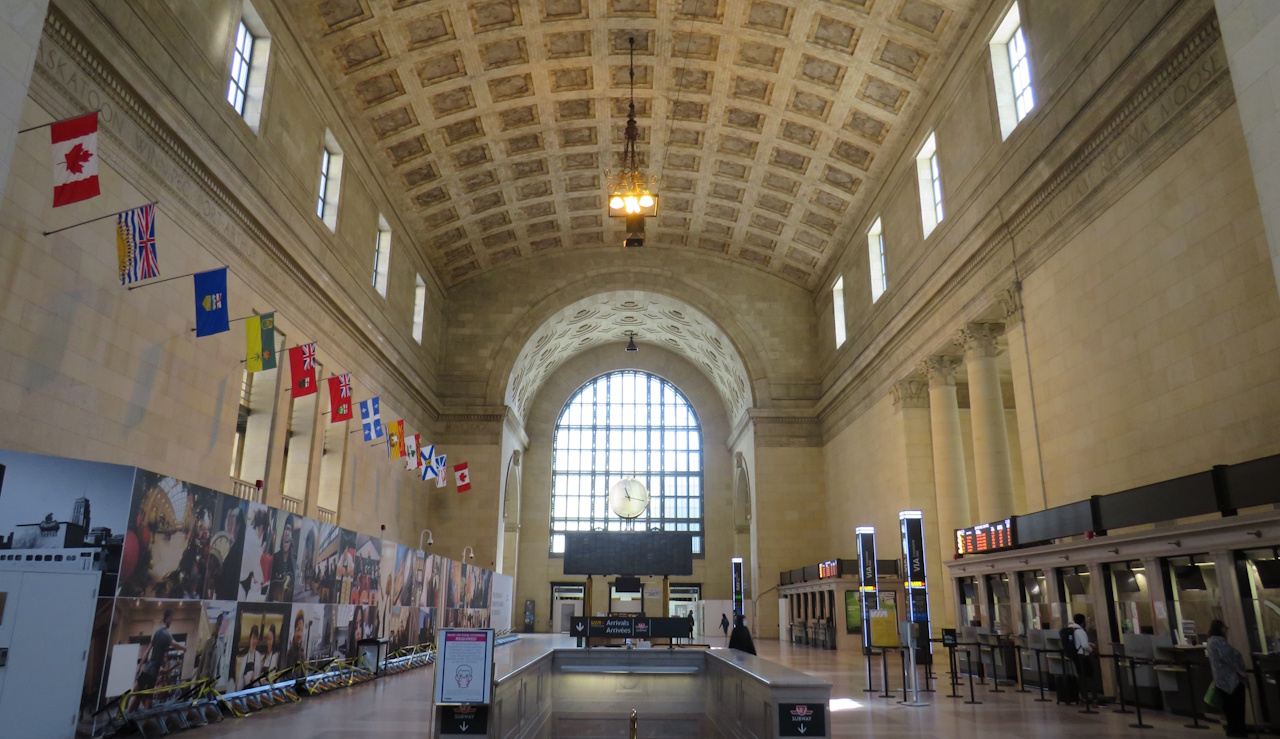
Union Station handles almost 70 million passengers a year, a scale that puts one downtown Toronto building in the same conversation as major national rail hubs. That number matters because the station is not just a front door for GO trains, VIA Rail, UP Express, the TTC subway, and streetcars. It is a layered operating system split across public ownership, railway infrastructure, heritage architecture, and everyday commuter shortcuts.
The City of Toronto owns most of the building, while GO owns key rail and concourse assets, and Toronto Terminals Railway still sits behind much of the corridor’s technical machinery. The useful question is not only what the station is, but how it works when 206,000 daily riders are moving through it. The answer explains why the 1927 Great Hall, the 6.4 km rail corridor, and a five-minute indoor walk to the bus terminal all belong in the same story.
Why this station sits at the center of downtown travel
According to Toronto Terminals Railway, Union Station handles almost 70 million passengers a year, with daily ridership approaching 206,000 and peak-period arrivals close to 187,000. That volume is the clearest reason the Front Street complex functions as Toronto’s major railway station and intermodal transportation hub rather than simply another downtown stop. Regional commuters, intercity rail passengers, subway riders, streetcar users, and pedestrians all converge there because the station sits where the city’s rail network meets the densest part of downtown.
Who owns it and who runs the trains
The people who own the marble halls are not the same people who own the rails above them. The City of Toronto owns the station building, while Metrolinx owns the train shed and trackage, according to GO Transit/Metrolinx. In practical terms, that means the civic landmark passengers walk through and the rail infrastructure trains use sit under different public hands, with planning and capital work divided accordingly.
That split dates to a shared-ownership arrangement established in 2000, when the City took ownership of most of the building and GO took control of key rail-facing assets, including the train shed, platforms, tracks, and York Concourse, according to GO Transit/Metrolinx. The distinction matters because a concourse renovation, platform change, or track-capacity project may involve different owners even when the passenger experience feels like one connected station. This is why upgrades can move in phases rather than as one tidy construction job.
Rail movement through the Union Station Rail Corridor is directed by Toronto Terminals Railway, a joint venture historically owned by CN and CP, now CN and CPKC. Toronto Terminals Railway says the corridor runs about 6.4 km and includes 14 station tracks, more than 180 signals, 250 switch machines, and 40 km of circulated track infrastructure. That is not just background engineering trivia; it explains why one late or rerouted train can affect several platforms and why dispatching has to be tightly controlled.
Operational responsibility is layered rather than simple. Toronto Terminals Railway was incorporated in 1906 and remains responsible for track and signal maintenance in the corridor, while its own 2026 materials note that Metrolinx Rail Traffic Controllers operate the rail control towers as of 2024.
The useful takeaway is straightforward: the station works because the building owner, the provincial transit agency, and the rail corridor operator all have defined roles. The downside is just as clear: meaningful changes require coordination across several agencies before riders see the payoff.
What the 1927 station tells us about Toronto’s rail history
The building most people rush through today is the current station constructed in 1927, which makes it a working piece of rail history rather than just a place to catch a train. That date matters because Toronto had earlier station versions, but the heritage status attaches to this specific Beaux-Arts terminal, not to a blurred timeline of every railway building that came before it.
Its national recognition came in stages. The station became a National Historic Site of Canada in 1975, according to the City of Toronto, placing it in the same category as places recognized for their importance to the country’s broader history. In 1989, it was designated a Heritage Railway Station, a more specific acknowledgement of its railway function and architectural character.
A few design facts explain why those labels are more than ceremonial. The Great Hall’s 22 Bedford limestone columns, each 40 feet high and weighing 75 tons, show the scale of civic ambition built into the terminal, according to the City of Toronto. That kind of permanent stone-and-column architecture was meant to make rail travel feel central to the city, not tucked behind it.
Heritage status also changes how modernization happens. Protected character does not stop upgrades, but it limits quick fixes that would damage key historic spaces or alter the building’s defining features.
That is why circulation improvements inside a station like this often require more planning than a plain concrete transit facility. The payoff is that Toronto keeps a landmark in daily use instead of preserving it as a static museum piece, which is the right outcome for a rail city.
How to move through the station without wasting time
Metrolinx’s wayfinding puts the indoor walk from the rail station to the bus terminal through Scotiabank Arena at 200 metres, which is only about five minutes if the right corridor is chosen first. That is the basic rule here: pick the side of the block and the operator needed before following the crowd, because the building rewards commitment and punishes wandering.
For TTC access, follow signs to Union on Line 1 rather than drifting into the rail concourses. The subway entrance sits inside the same complex, so transferring from GO Transit or VIA Rail does not require going outside. UP Express is also signed from within the station area, with its airport trains reached by following the dedicated UP markings rather than the general GO platform flow.
Bay Street and York Street are the two practical anchors for orientation. The Bay side works best for moves toward the Financial District, Scotiabank Arena, the GO bus terminal, and east-side connections.
The York side is usually the cleaner choice for west-side exits, Rogers Centre, the CN Tower area, and parts of the PATH that run toward the entertainment district. Treat those names as compass points, not decoration; they are the quickest way to stop second-guessing every hallway.
The rail side is not just a set of platforms under an old building. The Union Station Rail Corridor is the largest and busiest rail corridor in Canada, so platform assignments and concourse routing matter more here than at a smaller terminal. Check the departure board, then head to the named concourse or platform access point instead of waiting near the first staircase that looks plausible.
Accessibility routing has its own logic. Metrolinx guidance from 2025 directs barrier-free access for platforms 3–13 through York Concourse, while platforms 20–21 are reached barrier-free through the VIA Concourse. That detail saves backtracking, especially with luggage, mobility devices, strollers, or tight transfer windows.
The station is easier to move through than it used to be after the revitalization completed in July 2021, but it is still built around high-volume transit, not casual browsing. The efficient approach is simple: arrive by subway, train, airport rail, streetcar, or on foot; choose Bay or York as the main direction; then follow the operator-specific signs for TTC, GO, VIA, or UP Express without detouring into retail unless there is time to spare.
Where the station’s next capacity test begins
The station’s next test is not whether it can look restored or feel easier to navigate after years of construction. It is whether capacity, signage, and passenger habits can keep pace as Metrolinx pushes toward up to 80 trains per hour in peak periods. That changes the practical value of knowing the building before arriving.
The best move is to treat the place as a transfer district, not a single station with one obvious entrance. Pick the right concourse, stay inside for the 200-metre link to the bus terminal, and use TTC access instead of driving into the downtown core. The payoff is simple: fewer wrong turns in a building designed to move a city.
Frequently Asked Questions
Q: What is Union Station in Toronto used for?
A: Union Station is Toronto’s main rail hub and a major transfer point for regional and intercity travel. It connects GO Transit, VIA Rail, the TTC subway, UP Express, and other services, so it functions as a true intermodal station rather than just a train stop. That makes it the main link between downtown and the wider Greater Toronto Area.
Q: Where is Union Station located in downtown Toronto?
A: Union Station sits on Front Street West, on the south side of the block between Bay Street and York Street. That puts it in the core of downtown Toronto, with easy walking access to the Financial District, the waterfront, and major office towers. The TTC and streetcar connections also make it one of the easiest places in the city to move between neighborhoods without a car.
Q: Who owns and operates Union Station?
A: The City of Toronto owns the station building, while Metrolinx owns the train shed and trackage. Day-to-day train movement is controlled by Toronto Terminals Railway, a joint venture of CN and CP. That split matters because the station is both a public civic asset and a heavily used rail operations site.
Q: How old is Union Station and is it a heritage site?
A: The current Union Station was constructed in 1927. It has been a National Historic Site of Canada since 1975 and a Heritage Railway Station since 1989. Those designations reflect both its architectural value and its long role in Canadian rail history.
Q: Why is Union Station considered such an important transit hub?
A: Union Station anchors the Union Station Rail Corridor, which is the largest and busiest rail corridor in Canada. That status means it is not just busy by local standards; it is a central piece of the region’s transportation network. For travellers, the practical result is frequent service, strong transfers, and heavy foot traffic at peak times.