
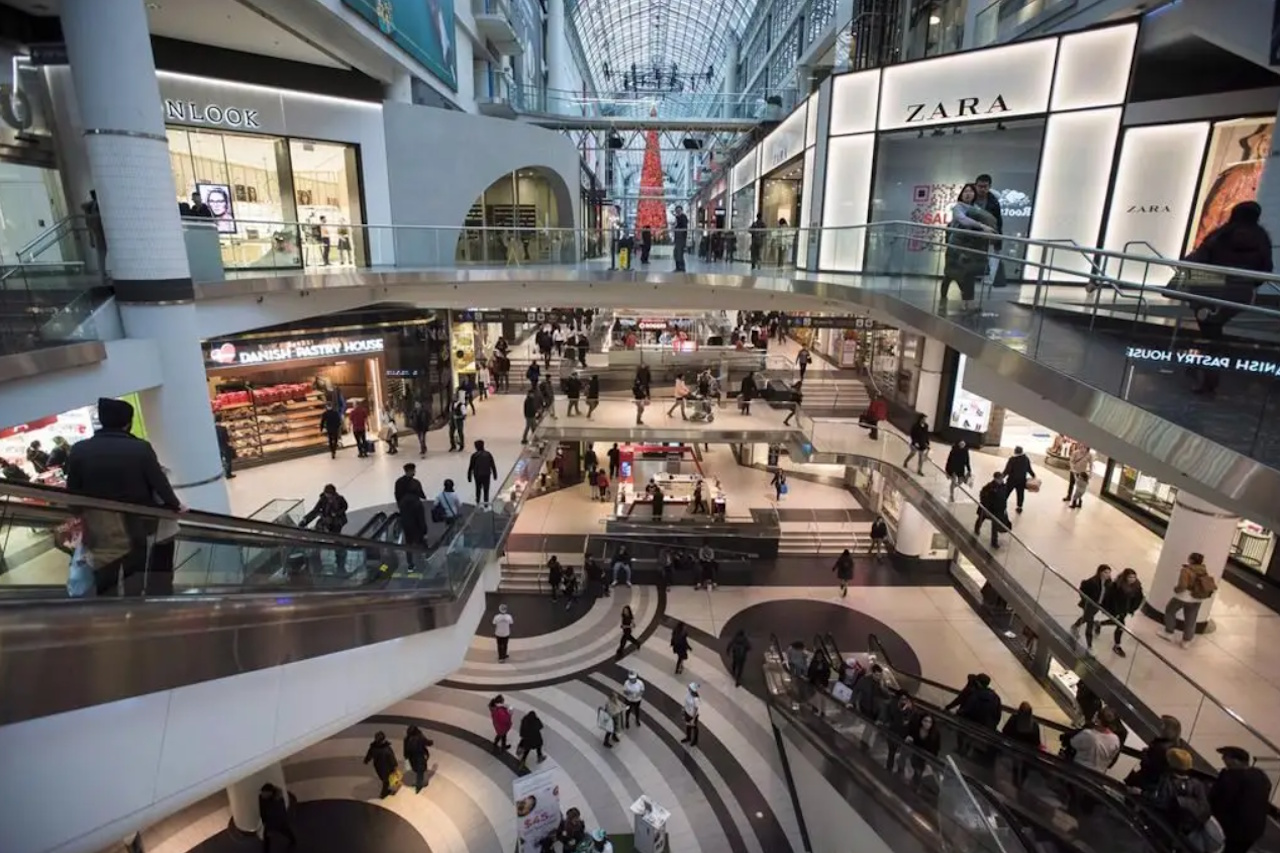
CF Toronto Eaton Centre is not a normal downtown mall: Cadillac Fairview’s 2025 brief lists 255 stores, 548,110 sq. ft. of retail space, and $1,622 in sales per square foot at the Yonge-Dundas core. That performance makes more sense when the mall is viewed as part shopping centre, part office complex, part pedestrian shortcut. Four office towers bring a 13,500-person work population into the same address, while the surrounding Downtown Yonge area draws nearly 70 million pedestrians a year.
The useful question is not whether the place is big, but how to use it without wasting time. The guide below focuses on car-free access through Queen Station, Dundas Station, streetcars, and the PATH, then separates the stores, food stops, and timing choices that actually change the visit.
What the mall covers and where it sits downtown
At Yonge and Dundas, the Eaton Centre behaves less like a stand-alone mall than a downtown spine: retail, offices, subway access, and lunch traffic all stack into the same block. Its full name is CF Toronto Eaton Centre, though most locals shorten it to Eaton Centre, and its official address is 220 Yonge St, Toronto, ON M5B 2H1. The site sits in the Downtown Yonge area near Yonge-Dundas Square, which is why it pulls in shoppers, office workers, students, tourists, and people simply cutting through the core.
Cadillac Fairview owns and manages the complex, and its own 2025 property brief frames the place as a high-performing downtown asset rather than a conventional enclosed mall: Cadillac Fairview lists 255 stores, 548,110 sq. ft. of CRU retail space, $1,622 in sales per sq. ft., and $4,096 in food-court sales per sq. ft. Those figures matter because they explain the tenant mix and the constant turnover of people. This is not a quiet suburban shopping centre transplanted downtown; it is a high-volume retail machine plugged into one of Toronto’s busiest pedestrian zones.
The office side changes the feel of the building just as much as the stores do. The complex includes 4 office towers, 2.4 million sq. ft. of office space, and an office population of 13,500, which helps explain the weekday lunch rush, the after-work wave, and the way some corridors feel more like commuter routes than browsing space.
For visitors, the practical takeaway is simple: the address marks a shopping destination, but the building functions as downtown infrastructure. Walking and TTC access fit the site better than driving to it.
How to get there without a car
Queen Station’s mall entrance sits just 32 metres west of Yonge Street, which makes the subway the cleanest way in when the sidewalks above are jammed. The two closest TTC stops are Queen Station and Dundas Station on Line 1.
Queen works best for the south end and direct indoor access; Dundas works best for the north end and the Yonge-Dundas side. According to the TTC, Queen Station has eight entrances and four elevators, so it is the more flexible choice when arriving with mobility needs, a stroller, or bad weather to dodge.
Yonge and Dundas is the easiest entry point for most visitors because it is obvious, central, and simple to find from the subway exit. It is not the calmest.
The intersection gets packed during commuter periods, lunch rushes, event spillover, and weekend afternoons, so the route is easy but the last block can feel slow. Anyone trying to move quickly should use the subway level or mall-connected entrances instead of fighting across the corner at street level.
Surface transit is useful when coming from nearby neighbourhoods that sit east or west of the core. The 501 Queen streetcar gets closest to Queen Street access, while the 505 Dundas streetcar lines up well with the Dundas side.
From Chinatown, Kensington Market, Cabbagetown, or Riverside, these streetcars usually make more sense than backtracking to a subway station first. Walking also works from City Hall, the Financial District, and St. Lawrence, but Dundas and Queen are the practical east-west spines.
From Union Station, the indoor PATH route is the better bad-weather move. Metrolinx says the PATH walk from Union to the Eaton Centre takes about 10 to 15 minutes and sits within a network of more than 30 kilometres connected to six subway stations.
The signage can be fussy, but the payoff is staying off the street entirely. Driving adds cost, traffic, and no real advantage for this location; transit and walking are the plan that actually fits the site.
Stores, food, and what is actually worth the time
The most useful recent shift is that former department-store space has been turned back into a real anchor: Retail Insider reported that La Maison Simons opened on September 18, 2025, across three levels and about 112,000 sq. ft. That matters because downtown malls need big-format stores to justify more than a quick pass-through, and Simons gives browsing visitors a clearer reason to stop rather than simply moving between familiar chains.
The retail mix is still mostly practical: national and international chain retailers, beauty and apparel stores, electronics and phone shops, footwear, accessories, pharmacies, and service businesses suited to errands. Cadillac Fairview’s 2025 property brief reported $1,622 in sales per square foot, which signals a high-performing downtown mall rather than a sleepy indoor shopping centre.
The tradeoff is predictability. The lineup is useful, especially for replacing a charger, buying cosmetics, finding weather-proof clothing, or handling several small tasks in one trip, but it does not replace the more specific character of Queen West, Kensington Market, Ossington, or Roncesvalles.
Food is strongest when treated as a convenience, not a destination meal. Queen’s Cross Food Hall opened in 2024 with 13 food stalls, two rotating pop-up stalls, a bar/café, and seating for 300 guests, according to Cadillac Fairview’s announcement through CNW. That gives the centre a better lunch and snack setup than the standard basement food-court routine, though peak meal periods still feel like downtown office traffic meeting mall traffic.
For a quick errand run, the centre works best when the stop has a clear target: one anchor store, one service counter, one food stop, then out. Longer browsing makes sense on bad-weather days, between downtown plans, or when checking flagships and new openings, but brand turnover is part of the deal in a mall this central. Anyone expecting independent Toronto retail will get more payoff on nearby street strips; anyone needing efficient, indoor, one-stop shopping will understand why this mall stays busy.
Best times to go and what crowds change
Saturday late afternoon is the roughest slot: BestTime’s 2026 crowd data identifies 5 p.m. on Saturdays as the centre’s most popular period, which lines up with the way downtown shopping, movie plans, restaurant meetups, and event spillover stack on top of each other. The practical effect is simple. Escalators slow down, washroom lines get longer, seating becomes harder to claim, and browsing turns into shuffling in the busier corridors.
Weekdays are not flat. Lunch hours pull in office workers, students, shoppers, and people cutting through between appointments, then the after-work period brings another wave as commuters and downtown workers merge with regular retail traffic.
The quieter play is Monday, which BestTime lists as the least busy day, especially outside lunch and the post-work rush. Mid-morning is the cleanest window for errands, returns, and quick store runs.
Crowds also rise when the area around Yonge-Dundas Square is active. The square, nearby theatres, street activity, and major downtown intersections push people through the mall even when they are not shopping there. Downtown Yonge BIA reported nearly 70 million pedestrians annually in the district in 2025, so the centre functions as part mall, part indoor pedestrian route.
That is useful in bad weather, but it changes the feel of a visit. On peak weekends, the smartest approach is to treat the building as a connector and pick specific stops rather than wandering aimlessly.
The crowd is not the same all day, and that matters. A focused visit before lunch is easier than one after work.
A rainy Saturday is usually more compressed than a clear Monday morning. Peak foot traffic is the downside, but it is also why the centre works so well as a dry, central link between transit, offices, shops, and the rest of downtown.
Why the transit-first plan beats the parking plan
The Eaton Centre works best when it is treated less like a destination to “do” and more like downtown infrastructure with shopping attached. Build the visit around transit, not parking: Queen Station puts Line 1 directly under the mall, and the PATH walk from Union takes about 10 to 15 minutes indoors. That changes the practical value of the place in bad weather, during lunch breaks, and between nearby stops such as City Hall, Massey Hall, and Yonge-Dundas Square.
The crowd pattern is the deciding detail. A Monday morning visit and a Saturday 5 p.m. visit are two different experiences inside the same building.
Frequently Asked Questions
Q: Where is CF Toronto Eaton Centre located in Toronto?
A: CF Toronto Eaton Centre is at 220 Yonge St in downtown Toronto, right by Yonge-Dundas. The site sits in the core of the city, so it is easy to pair with nearby stops, office towers, and the subway network.
Q: What is the best TTC stop for the Eaton Centre?
A: The most direct TTC access is via Dundas station on the subway, which puts the mall right at street level. Queen station is also a practical option for the south end, and both are easier than driving and parking in the area.
Q: Is there a phone number for the Eaton Centre?
A: Yes. The main contact number is (416) 598-8560. That is the clearest place to confirm store hours, mall services, or current access details before heading downtown.
Q: Is CF Toronto Eaton Centre easy to reach on foot from other downtown areas?
A: Yes. The centre is built for walking access from Yonge Street, Dundas Square, and the surrounding office district. For visitors moving between downtown neighborhoods, the subway and streetcar connections usually make more sense than a car.
Q: Who owns and manages CF Toronto Eaton Centre?
A: CF Toronto Eaton Centre is owned and managed by Cadillac Fairview. That matters because mall operations, tenant mix, and property updates are handled through a major commercial real estate operator rather than a standalone local landlord.