
The Toronto Blue Jays drew 2,681,236 fans in 2024, third in the American League… even though the season itself fell short. That gap matters.
Most teams lose momentum when the wins dry up; Toronto still packs Rogers Centre, still spends like a heavyweight, and still carries a reach that stretches far beyond one city. What’s often missed about the Toronto Blue Jays is that they aren’t just Canada’s lone MLB club.
They sit in a strange, powerful middle ground: a franchise valued at $2.15 billion by Forbes in 2025, playing in a $300 million renovated downtown ballpark, while operating above MLB’s luxury-tax line at a level that says this team expects to matter.
If you want to understand who the Blue Jays are, where they fit in baseball, and why home games at Front and John feel bigger than a local event, start there.
Who the Toronto Blue Jays are
One club carries Canada’s entire Major League Baseball identity, and that alone makes the Blue Jays unusual. They are a Canadian professional baseball team based in Toronto, Ontario, and they compete in MLB as a member of the American League East Division.
That’s the fast version, but the bigger point is this: they aren’t just Toronto’s team in a league full of U.S. clubs. They are the only MLB team based in Canada.
That national role gives the franchise a reach most teams don’t have. If you follow baseball from Vancouver, Halifax, or anywhere in between, this is the big-league club tied to your country.
I think that’s what people outside Canada sometimes miss — the fan base isn’t only local or even regional in the usual sense. It can feel national in a way almost no other team in MLB can match.
But the badge comes with a hard reality. Representing all of Canada sounds glamorous until you remember where they play: the AL East, a division that has long been one of baseball’s toughest neighborhoods.
So while the Blue Jays have a distinct identity and a whole country behind them, they still have to survive the same brutal divisional grind as everyone else in that race.
They also aren’t some fringe outpost on the edge of the sport. The Blue Jays are fully embedded in MLB’s structure — same league, same schedule demands, same pressure to compete — while standing apart because no other franchise carries the Canadian flag at this level.
That mix is the clearest way to understand who they are: a Toronto-based team with a national footprint, playing in one of baseball’s hardest divisions.
How the Blue Jays fit into MLB
Nineteen games against each division opponent can swing a season faster than almost anything else in baseball. That’s why the Blue Jays’ place in MLB isn’t just about conference labels or league charts — it’s about surviving a schedule loaded with familiar opponents who can bury you in the standings by mid-summer.
Their direct competition in the AL East is brutal: the New York Yankees, Boston Red Sox, Tampa Bay Rays, and Baltimore Orioles. That mix matters more than casual fans realize.
The club shares its division with three U.S. East Coast teams and one Florida team, which means the calendar keeps dragging them back into the same pressure points over and over.
You don’t get many soft stretches in this group, and that’s exactly what makes the division such a grind.
A full MLB season runs 162 games, which sounds like enough time to smooth out a few bad weeks. But divisional games carry extra weight because every win does two jobs at once: it helps your own record and hands a loss to a team you’re chasing.
That’s the part people miss. A 4-game swing against Baltimore or New York in June can echo all the way into the wild-card race in September.
That creates the central contrast around the Blue Jays. Their Canadian identity makes them stand out in the league, but the season is built around frequent, high-stakes series against U.S. rivals who see them constantly.
In other words, they may feel distinct, yet the day-to-day reality is pure MLB pressure: repeat matchups, tight standings, and very little room to coast.
Rogers Centre and home games in downtown Toronto
A retractable roof changes baseball more than most fans admit. Since 1989, the club has played its home games primarily at Rogers Centre, and that roof is a huge reason the building matters in a city where April can feel like two different seasons in the same week.
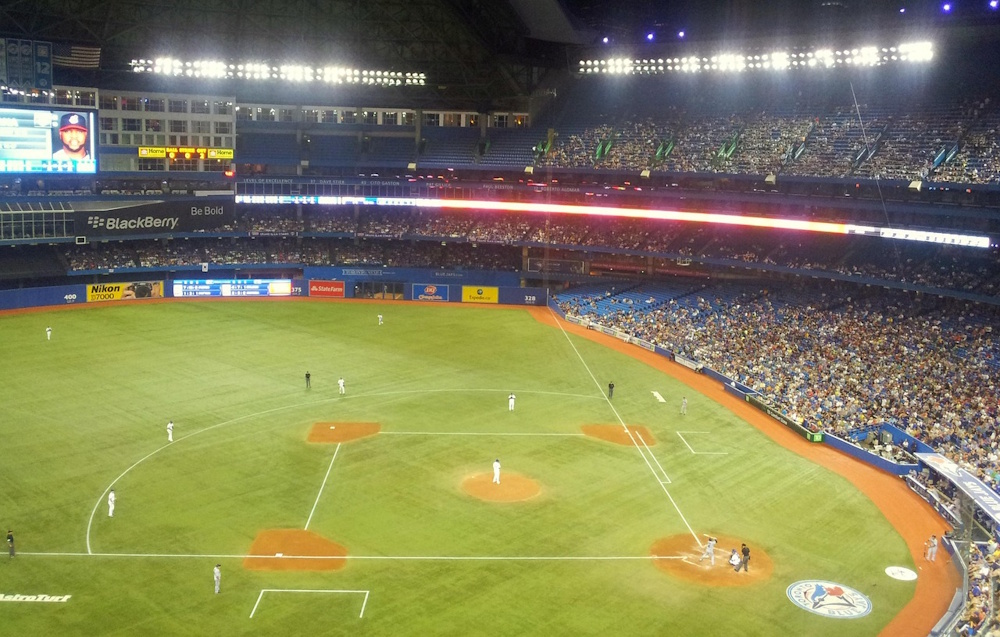
You can buy tickets without obsessing over a cold front or a rainy forecast, which makes early-season and midsummer games far easier to plan.
Downtown placement does the rest. Rogers Centre sits near the CN Tower and the waterfront core, and the team says the ballpark is at Front and John Streets within walking distance of Union Station and St. Andrew Station.
That sounds like a small logistics note, but it shapes the whole rhythm of a home game: commuters can flow in after work, out-of-town fans can arrive by train, and the stadium feels tied to the center of the city rather than parked on the outskirts.
The tradeoff is real, though. A weather-proof home field is practical, but it doesn’t feel quite like a classic open-air park where the sky, wind, and late-summer light become part of the game.
Rogers Centre can feel more controlled, more enclosed, sometimes even a little less romantic. I think that’s the right bargain for Toronto. Reliable baseball beats nostalgia when you’re trying to fill seats over a long season.
Recent changes pushed the place closer to a true baseball venue instead of a generic big stadium.
The team’s 2023-24 renovation project was announced at $300 million, and the club said the 2024 rebuild cut roughly 3,000 square feet of foul territory on the 100 level to bring fans closer to the field. You feel that difference.
The building still has its own personality, but now home games feel tighter, louder, and more connected to the action.
Why the Toronto Blue Jays still matter
Back-to-back titles in 1992 and 1993 still give this club a place in Canadian sports memory that most baseball teams would kill for.
Those championships matter not just because they happened, but because they set the standard for what fans expect. A team with that kind of history isn’t judged like a novelty or a niche property. It’s judged like it should matter in October.
That reach goes far beyond the city itself. The fan base stretches across the country in a way few North American teams can match, which is why the Jays feel different when they’re good: they don’t just light up one market, they pull in attention from coast to coast.
Sportsnet reported that Game 7 of the 2025 World Series averaged 10.9 million viewers in Canada, with 18.5 million Canadians watching some or all of the game.
That’s nearly 45% of the population paying attention to baseball on the biggest stage. If you want proof that this sport can still command national interest here, that’s it.
Money tells the same story. Forbes valued the club at $2.15 billion in 2025, 14th in MLB, and Spotrac listed its 2025 luxury-tax payroll at $286,135,551, which put it $45,135,551 above the tax threshold.
That’s not how a fringe brand operates. It’s how a major national sports business behaves, especially one expected to contend.
But this is the tension that defines the team now: the banner years are real, yet history alone doesn’t carry a franchise forever. What keeps the Jays relevant is the mix of old credibility and current stakes.
Even after a losing 2024 season, they still drew 2,681,236 fans—33,102 a game, third in the American League, according to Baseball-Reference.
I think that says everything. The Blue Jays still matter because when they’re in the playoff race, they stop being just a baseball team and become a national event. The hard part is turning that pull into sustained modern success instead of asking fans to live on memory.
Conclusion
The Toronto Blue Jays matter for more than nostalgia or national symbolism. They draw like a contender, spend like a big-market club, and play in a downtown stadium rebuilt to make baseball feel tighter, louder, and less like an old multipurpose relic. That mix is rare.
A team can have money without identity, or identity without real muscle; Toronto has both, even when the standings don’t flatter them.
That’s why the Blue Jays still sit in an unusual place inside MLB—and why paying attention to them tells you something larger about where baseball is headed.
When one franchise can carry a city, a country, and a serious payroll at the same time, it stops being just a team and starts becoming a pressure test for the sport itself.
Frequently Asked Questions
Where do the Toronto Blue Jays play home games?
They play primarily at Rogers Centre in downtown Toronto. That’s been their home since 1989, and it’s a big part of the team’s identity. The location matters because it puts the club right in the middle of the city, but it also means the ballpark experience is very different from an open-air stadium.
What league are the Toronto Blue Jays in?
The Blue Jays compete in Major League Baseball as a member of the American League East Division. That puts them in one of baseball’s toughest divisions, where every game can matter. If you follow the team, you’re following a club that faces heavy competition all season long.
Are the Toronto Blue Jays a Canadian team?
Yes. They’re a Canadian professional baseball team based in Toronto. That makes them the only MLB club based in Canada, which gives them a national fan base that stretches well beyond the city.
Why is Rogers Centre important to the Blue Jays?
Rogers Centre has been the team’s primary home since 1989, so it’s tied to decades of Blue Jays history. Fans know it for its downtown location and indoor setup, which changes the game-day feel compared with most MLB parks. That’s a plus for comfort, but it also changes how baseball plays there.
What should I know before following the Toronto Blue Jays?
Start with the basics: they’re a Toronto-based MLB team in the AL East, and they’ve played at Rogers Centre since 1989. That tells you a lot about who they are and where they fit in the league. The surprise is how much their Canadian identity shapes the fan experience, even though they compete in an American-based league.